
Face value is the ticket's original base price, set by the event organizer or printed directly on the ticket, before any service fees, processing charges, or resale markups get added. It's the number the venue or promoter decided the seat was worth, not the total you pay at checkout and not what someone might charge for it on the secondary market. Everything else layered on top, from convenience fees to scalper markups, is a separate conversation.
TL;DR:
- Face value represents the original price set by the event organizer, excluding service fees, taxes, or resale markups.
- Resale prices are driven by market demand and often differ significantly from face value, sometimes exceeding or falling below it.
- Some events restrict resale prices to face value or a small percentage above to protect fans from excessive markups, but this varies by organizer and event.
- Confirming face value requires checking original purchase receipts, official pricing pages, or the ticket itself for itemized cost details.
- Resale prices can be unpredictable, with high demand raising prices well above face value and low demand sometimes pushing sales below original cost.
Table of Contents
- What Face Value Tickets Meaning Includes (and What It Doesn't)
- Face Value vs Resale Value: Why the Two Numbers Rarely Match
- How Face-Value Resale Caps Work on Ticketing Platforms
- How to Find and Verify a Ticket's Face Value
- Three Quick Scenarios That Clear Up the Confusion
- How Capital City Tickets Handles Pricing Transparency
- Where Capital City Tickets Fits When You're Buying Tickets
- Sources
- FAQ
What Face Value Tickets Meaning Includes (and What It Doesn't)
Face value is the base price the event organizer assigns to a seat, according to the definition of face value tickets that dictionaries and reference sources use across contexts, from tickets to currency. Oxford Learner's Dictionaries defines it plainly as the value printed on the front of an item, and applied to a ticket, that's the original stated price before anything else gets tacked on.
What face value does not include is almost everything that shows up further down your checkout screen. Here's what typically gets added separately:
- Service fees charged by the ticketing platform
- Processing or convenience fees
- Shipping costs for physical tickets
- Applicable sales tax, depending on state and venue
- Sometimes a facility fee set by the venue itself
Pro Tip: If a checkout screen shows one lump sum with no breakdown, that's a signal to look closer. Legitimate platforms typically itemize face value separately from fees, a practice rooted in how ticketing pricing is designed to be shown, according to general explanations of face value.
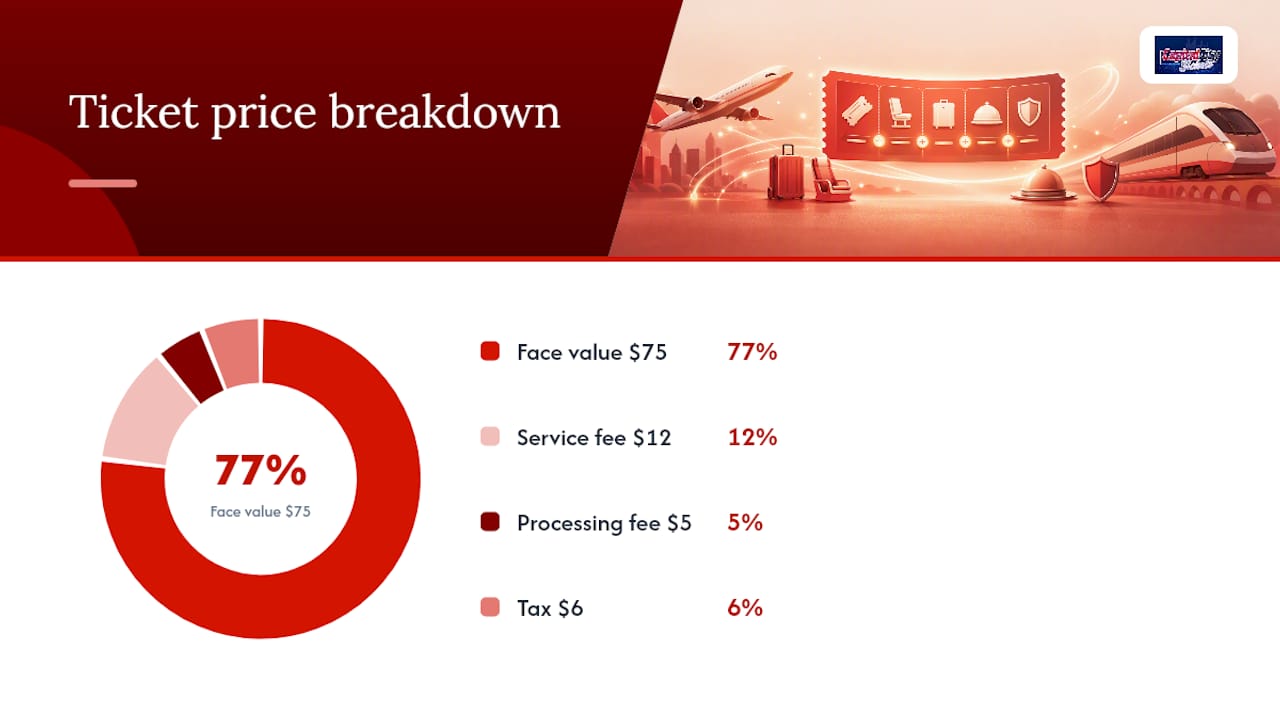
Picture a $75 concert ticket. The face value is $75. Add a $12 service fee, a $5 processing fee, and $6 in tax, and your total comes to $98. The face value never changed. Only the amount you owed did.
Face Value vs Resale Value: Why the Two Numbers Rarely Match
Resale value is what a comparable ticket is actually selling for on the secondary market right now, and it has almost nothing to do with what the original organizer charged. This is the core of the face value vs resale distinction that trips up most buyers. Resale value tracks current market conditions, not the printed price from months earlier.
There's a subtlety here that matters: an asking price and a sold price are not the same thing. A seller can list a ticket for triple its face value all day long, but that listing means nothing until someone actually buys it at that number. Sold-price data is the reliable signal; asking prices are just hopeful math.
That's why resale prices swing in both directions:
- Above face value: A sold-out stadium show, a surprise reunion tour, or a playoff game creates demand that outstrips supply, so resale prices climb well past the printed cost.
- Below face value: A weeknight minor-league game, a touring act that didn't sell as expected, or a listing posted an hour before doors open can all sell for less than face value, because the seller wants a guaranteed sale over an empty seat.
Face value can also be a moving target on its own. Some organizations report an average face value across a season, while individual games or shows carry their own variable pricing depending on opponent, day of week, or artist demand, a distinction ticketing-data explainers point out regularly because fans conflate the two. A $40 average face value for a season ticket package doesn't mean every single game costs $40.
How Face-Value Resale Caps Work on Ticketing Platforms
Some artists and organizers cap resale prices at or near face value, and understanding why helps you spot when a deal is real. The general principle: certain performers, particularly ones focused on fan access over profit, instruct organizers to limit how much a ticket can resell for. This protects fans from markup, though it isn't universal, and plenty of events allow resale at whatever the market will bear.
Here's how organizers and platforms generally enforce it:
- Listing controls restrict what price a seller can enter for a capped event, often locking the ceiling at face value or a small percentage above it.
- Labeling on the resale listing identifies it as a face-value exchange or verified resale, so buyers know the price is capped rather than market-driven.
- Payout workflows route the transaction through the platform itself rather than a private sale, which is how the cap gets enforced instead of just suggested.
Pro Tip: Never assume a cap applies just because one show you attended had one. Check the specific event or organizer's own policy page, since face-value limits are set per artist or per tour, not as an industry-wide rule.
How to Find and Verify a Ticket's Face Value
Confirming face value yourself takes about two minutes if you know where to look.
- Check your confirmation email. Most purchase confirmations itemize the base ticket price separately from fees and tax.
- Look at the e-ticket image itself. Many digital tickets print the face value directly on the ticket face, consistent with how the term originated for printed goods.
- Pull up your order history on the platform you bought through; it usually shows the same line-item breakdown as your original receipt.
- Compare against the venue or organizer's official pricing page, if the event is still listed, to confirm the number matches what was originally advertised.
Watch for red flags when checking someone else's listing: a seller who won't discuss fees, a price with no itemization at all, or a receipt that conveniently can't be produced. Those gaps usually mean the number you're being quoted isn't face value at all.
Three Quick Scenarios That Clear Up the Confusion
- Buying at release: You buy a $60 ticket the day it goes on sale. That's face value. A friend buys the same seat category two weeks later on a resale site for $110 because the show sold out. Same seat category, two different prices.
- Season tickets vs single games: Your season package averages $45 a game in face value, but a rivalry game might carry a $70 face value while a Tuesday night game carries $30. Averages hide real variation.
- Late resale below face value: A seller lists a $50 ticket for $35 an hour before showtime because an empty seat is worse than a small loss. Face value stayed at $50. The sold price didn't match it.
How Capital City Tickets Handles Pricing Transparency
Some ticketing platforms emphasize pricing transparency and customer service to help buyers understand charges and verify authenticity.
— Capital City Tickets
Where Capital City Tickets Fits When You're Buying Tickets
If you've made it this far, you know the difference between face value and the total you'll actually pay, and you know resale prices can swing either direction depending on demand. Capital City Tickets makes that math simple: browse concert tickets, sports tickets, or theater tickets nationwide with a 100% guarantee on authenticity and delivery backing every order.
Certain platforms provide transparent pricing and last-minute ticket options for events that are nearly sold out. Whether you're chasing a touring artist's stop at a venue like Herbst Theatre or a performing-arts event at a hall hosting something like Die Fledermaus, the checkout process shows you what you're buying before you commit. Browse current listings and see the breakdown for yourself before your event sells out.
Sources
- Face value — Wikipedia
- face value | Definition at Oxford Learner's Dictionaries
- What Is Resale Value & How to Calculate It | ResaleSonar
- Face Value Vs. Resale Value - TiqAssist
FAQ
What Is a Face Value Exchange Ticket?
A face-value exchange is a resale option where a platform lets fans resell tickets at or near the original printed price instead of market rates. Organizers or artists set these limits to protect fans from markup, and the listing is usually labeled to show it's capped rather than open-market pricing.
Are Face Value Tickets Cheaper Than Resale Tickets?
Usually, yes, since face value reflects the organizer's original price before demand-driven markups kick in on the secondary market. But it isn't guaranteed. A low-demand event can see resale prices drop below face value, especially close to showtime.
Can You Sell Tickets Higher Than Face Value?
In most cases, yes, since ticket resale is generally legal in the United States and prices are set by the seller based on demand. Some states and specific events impose resale caps or anti-scalping restrictions, so it depends on local law and the organizer's own policy for that event.
How Much Are Tickets for a Major Concert Tour?
Pricing varies widely by artist, venue, and how close to the event you're buying, with face value set by the promoter and resale prices shifting with demand. Current listings and pricing for specific shows are available directly on the Capital City Tickets site.
Recommended
- Ahab The Ticket Whaler Presents Safe Ticket Whaling Tickets at Webster Theater – Hartford, CT
- Cars Tickets at Cheyenne Civic Center – Cheyenne, WY
- 40th Anniversary Concert Tickets at Herbst Theatre – San Francisco, CA
- Beautiful: The Carole King Musical Tickets at Lutcher Theater for the Performing Arts – Orange, TX