
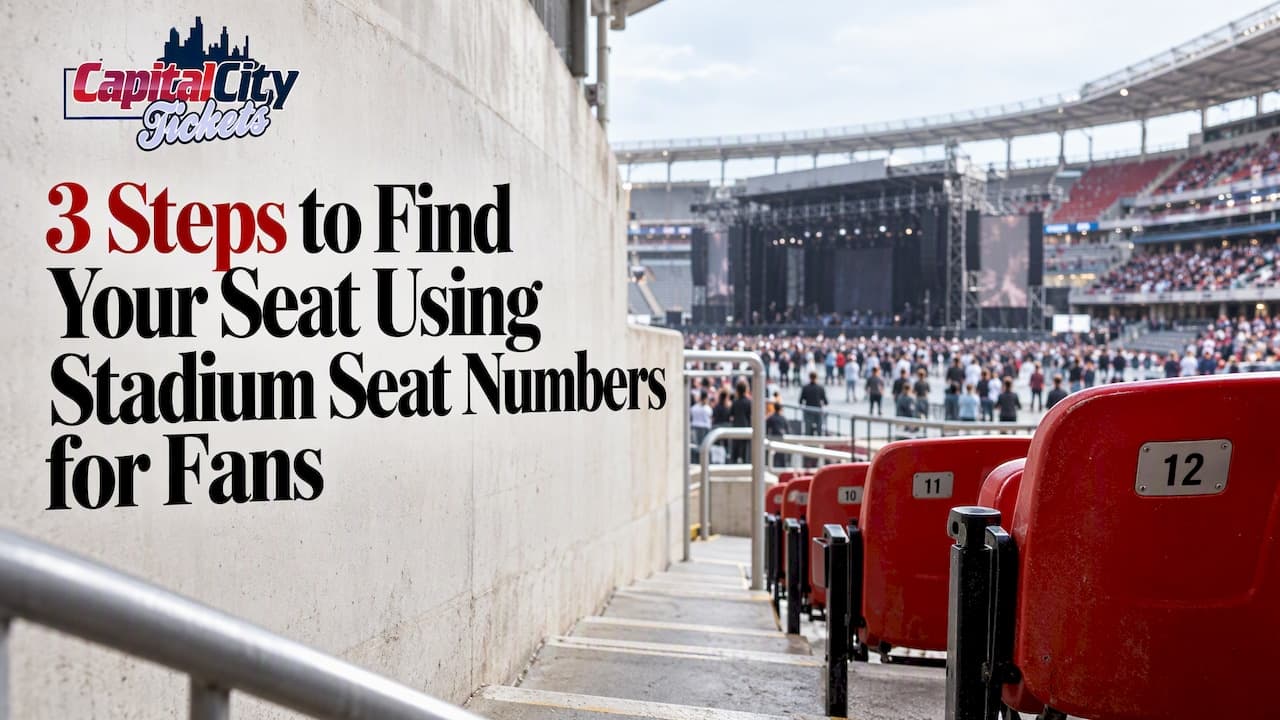
A stadium ticket code like Section 112, Row K, Seat 9 tells you exactly where to sit: the section is the seating block, the row is the horizontal line within it, and the seat is your specific spot in that line. The fastest way to confirm it is to pull up the venue's official seating chart and match section, then row, then seat, since numbering habits differ from stadium to stadium.
TL;DR:
- Seat numbering patterns vary by venue, with some using odd and even sequences by aisle, and others starting from the field or concourse, requiring venue-specific confirmation.
- Row labels may be alphabetic or numeric and can count from the field or the entrance, so check the venue's typical practice before assuming seat proximity.
- Major stadiums can expand capacity with standing-room and temporary seating, meaning ticket capacity is not fixed and varies by event.
- Official seating charts often use color-coding, section ranges, and 3D views to clarify seat locations, but verifying with the venue’s official map is crucial for accuracy.
- Accurate seat identification depends on following signage, checking seat numbers on the back or aisles, and consulting venue staff if uncertainties remain.
Table of Contents
- Key Terms: Section, Row, Seat, Aisle, and Levels
- Common Seat Numbering Patterns and What They Mean
- Special Seating Types: Suites, Floor Seats, and Standing Room
- How to Read an Official Seating Chart Online
- Finding Your Seat Once You're at the Stadium
- Accessibility and ADA Seating: What to Check Before You Go
- What We've Learned Helping Fans Find the Right Seats
- Buy Your Tickets With Seating Clarity Built In
- FAQ
- Sources
Key Terms: Section, Row, Seat, Aisle, and Levels
Before you can trust any seating chart, it helps to know what each label actually means. A section is a defined block of seats, usually numbered and separated from neighboring blocks by aisles, rails or concourse walls. A row is a single horizontal line of seats within that section, and a seat is your individual spot in that row. Tickets typically print this information in the same order: section, then row, then seat, so a code reading "Sec 212, Row F, Seat 14" means you're in section 212, sixth row back (if rows start at A), fourteenth seat in.
A few more terms show up often on venue charts:
- Aisle: the walkway between seating blocks, often used as a reference point for counting seats.
- Gate: the entry point into the building, which usually corresponds to a cluster of nearby sections.
- Level: the vertical tier, such as lower, club or upper, that groups sections by height and price.
- Zone: a broader grouping of sections used mainly for pricing or concourse navigation.
Row labeling isn't universal. Some venues use letters (A, B, C), others use numbers, and a few restart numbering in each section rather than running continuously around the bowl. Before you assume Row 1 is closest to the field, check whether that particular venue counts rows from the field up or from the concourse down. That single detail resolves most of the confusion fans run into when comparing seats across different stadiums.
Common Seat Numbering Patterns and What They Mean
Seat numbering follows a handful of recurring conventions, though no single rule applies everywhere. Spotting which pattern a venue uses makes it much easier to picture your seat before you ever walk in.
- Odd and even by aisle: In many arenas, seat 1 sits at one aisle and seat numbers climb toward the opposite aisle, with odd numbers on one side and even numbers on the other. This isn't standardized across every building, so treat it as a starting guess rather than a rule.
- Rows counted from field or from concourse: Some venues label Row 1 as the closest row to the field or court, with letters or numbers increasing as you move up and back. Others flip that, starting the count at the concourse entrance and decreasing toward the field. A Row K seat could be near the front in one stadium and near the back in another.
- Sections numbered clockwise or end to end: Many football and baseball stadiums number sections sequentially around the bowl, often starting near one end zone or along the first-base line and increasing clockwise. Basketball arenas sometimes number by quadrant instead.
In practice, this means two tickets with similar-looking codes, say Section 105 at two different stadiums, can put you in completely different spots relative to the field. The only reliable fix is checking that specific venue's chart rather than relying on patterns from a stadium you've visited before.
Special Seating Types: Suites, Floor Seats, and Standing Room

Not every ticket fits the standard section-row-seat format. Suites are usually labeled by a suite number or a defined range rather than individual seats, since the whole space is typically sold or reserved as a unit. Club seats sit inside their own numbered sections, which may have separate row logic from the general seating bowl.
Concert floor and pit tickets add another layer of complexity:
- Numbered floor rows mirror standard seating with assigned rows and seats, often arranged in a grid facing the stage.
- General admission (GA) floor has no fixed seats at all, just zones or entry order.
- Stage orientation changes everything: for concerts, temporary staging can renumber or eliminate sections that exist for sports events in the same building.
Standing-room-only (SRO) tickets are a separate category again, typically unassigned areas along the concourse or rear of the bowl, and they factor into how a venue defines its total capacity for a given night. AT&T Stadium has a base capacity of about 80,000 but can expand to roughly 100,000 for major events using standing-room and temporary seating configurations, which is a useful reminder that "capacity" on a ticket listing isn't a fixed number.
How to Read an Official Seating Chart Online
Most venues now publish detailed charts that let you confirm your seat before you ever arrive, and working through them in order saves confusion later.
- Start on the venue's official seating-chart page and locate your section number on the main map.
- Where available, switch to a 3D or seat-view mode to confirm your row's sightline. The Progressive Field 3D seating chart, for example, lets fans rotate the view to see what a given row actually looks out on.
- Cross-reference any color-coded table, since many venues group sections by price band using color blocks rather than listing every section individually.
The 2026 Albertsons Stadium seating chart is a good example of this format, pairing a visual map with a table that links colors to section ranges and price tiers:
| Color band | Section range | General price tier |
|---|---|---|
| Example band A | Lower bowl sections | Higher tier |
| Example band B | Mid-level sections | Mid tier |
| Example band C | Upper-level sections | Lower tier |
Pages like the State Farm Stadium seating chart also list general seating alongside accessible seating and event-specific details, so check the legend carefully rather than guessing which color applies to your section. If anything still looks unclear, a seat-view photo or a quick note from the box office can confirm what the chart implies.
Finding Your Seat Once You're at the Stadium
Once you're through the gate, locating your actual seat comes down to a few repeatable steps.
- Follow posted signage toward your section number, then look for row markers printed on stair rails or aisle walls to confirm you're in the right line.
- Check the seat back or the aisle-end plate for the printed seat number. If it's worn off or missing, count seats from a clearly labeled one nearby.
- If you're still unsure, show your ticket to an usher or box office staff member. They can confirm your exact row and seat or point you toward companion and ADA seating if needed.
Pro Tip: Arrive 15 to 20 minutes earlier than you normally would at large stadiums, and pull up the venue's app or a concourse map while you walk in, since big venues can have several gates that look identical from the outside.
Accessibility and ADA Seating: What to Check Before You Go
Accessible seating is typically marked on official charts with a distinct symbol, separate from the standard colored section blocks, and often grouped into dedicated ADA platforms rather than scattered throughout the bowl.
- Look for ADA icons or a dedicated accessible seating overlay on the venue's chart, often paired with companion seat locations right next to them.
- When booking, ask specifically about companion seats and any aisle or elevator transfer points you'll need to use to reach your row.
- If the chart doesn't make ingress and egress routes clear, call the venue's box office directly. The State Farm Stadium seating page is a good example of a venue that lists ADA seating alongside contact details for accommodations.
What We've Learned Helping Fans Find the Right Seats
Over more than 20 years connecting fans with live events, we've seen how often a seat mix-up traces back to skipping the venue's own chart and guessing instead. Our standing advice is simple: check the official chart, use seat-view photos when they're available and call the box office if a label still looks ambiguous.
— Capital City Tickets
Buy Your Tickets With Seating Clarity Built In
Finding the right seat starts with finding the right ticket, and that's where we come in. We offer concert tickets, sports tickets and theatre tickets across a wide lineup of events nationwide, backed by a 100% guarantee on authenticity and delivery for every purchase.
Our site lets you filter by venue, date and city before you commit, so you can check a section against the official seating chart while you shop. Whether you're headed to a stadium concert or a theater show, we make it simple to line up your seat preferences with available tickets. Browse our current sports tickets lineup and lock in your seats before the best sections sell out.
FAQ
How are stadium seats numbered?
Stadium seats are generally numbered within a section, with rows labeled by letters or numbers and individual seats numbered in sequence across each row. The exact order, including which side seat 1 falls on and whether rows count from the field or the concourse, varies by venue, so the official seating chart is the only reliable confirmation.
What stadiums seat 100,000 people?
Capacity can shift by event rather than staying fixed, since many large stadiums add standing-room or temporary seating for bigger occasions. AT&T Stadium, for instance, holds a base capacity of about 80,000 but can expand to roughly 100,000 for major events using those temporary configurations.
What is a stadium seating layout?
A seating layout organizes a venue into levels (such as lower, club and upper), each divided into numbered sections, which are then split into rows and individual seats. Charts from venues like State Farm Stadium typically show this hierarchy visually, often with ADA seating and event-specific sections marked separately.
How do I read stadium seat numbers on my ticket?
Your ticket lists section, row and seat in that order, so start by locating your section on the venue's official chart, then find your row, then count to your seat number. Some venues also publish PDF maps, like the MetLife Stadium seating chart, that break sections down to the row level for extra clarity.
Why do some venues renumber sections for concerts?
Temporary staging for concerts often covers part of the field or court, which can eliminate some sections entirely or shift floor seating into a new numbered grid built just for that show. This is common with floor and pit configurations, so always check the event-specific chart rather than the venue's standard sports layout.
Sources
- AT&T Stadium — MeetStadium
- 2026 Albertsons Stadium seating chart — Boise State University Athletics
- Progressive Field 3D Seating Chart — Cleveland Guardians
- Seating Chart | State Farm Stadium