
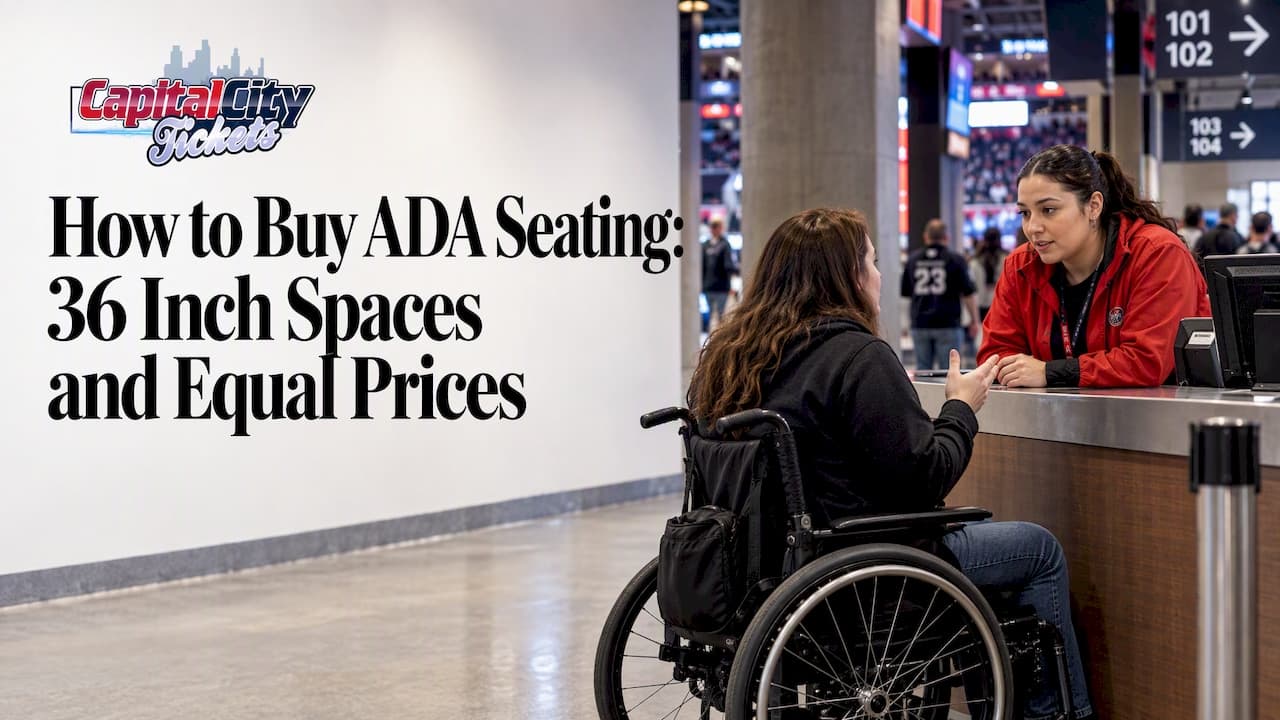
Accessible seating refers to seats built with the clear floor space, sightlines, and features required for people with disabilities to attend an event alongside everyone else. If you qualify to use it, you have key rights: anyone can purchase it on your behalf, it must cost the same as comparable non-accessible seats, and it must be sold through the same presales, phone lines, and websites as every other ticket. No medical proof is typically required, and you can typically add companion seats next to your own.
TL;DR:
- Wheelchair spaces need at least 36 inches of width and 48 inches of depth for front or rear entry, or 60 inches for side entry.
- Accessible seats must be included in presales and other sales channels at comparable prices, including fees; if they appear unavailable, call the box office.
- Buyers may purchase up to three adjacent companion seats when available, and can generally exchange a standard ticket for comparable accessible seating when available.
- Single event buyers do not need medical documents, though sellers may request verbal attestation; season ticket buyers may be asked for written assurance.
- If a venue denies access or charges more, contact guest services, request a manager’s written response, and report unresolved complaints to the Department of Justice.
Table of Contents
- What accessible seating is and who can use it
- Types of accessible seating and the dimensions that matter
- How accessible seats must be sold and priced
- Purchasing rules for companions, transfers, and proof
- How venues and sellers must identify accessible seats
- What to do if your accessible seating rights are violated
- Tips from Capital City Tickets on buying accessible seats online
- Why clearer accessible seating listings matter
- Find accessible seating through Capital City Tickets
- FAQ
- Sources
What accessible seating is and who can use it
The ADA treats ticket sales as a matter of equal opportunity: if a seat exists for the general public, an equivalent option has to exist for people who need specific accessibility features. Accessible seating is meant for people who use wheelchairs or other mobility devices, who need room for a service animal, or who cannot use a standard fixed seat because of a disability, according to the DOJ's ADA ticket sales guidance.
Preferring more legroom or an aisle view does not make someone eligible. Eligibility is tied to an actual access need, not personal comfort. That said, you do not have to be the one with the disability to buy the ticket. A family member, friend, or assistant can purchase accessible seats on behalf of someone who needs them.
- Wheelchair and mobility-device users qualify for wheelchair spaces.
- People needing space for a service animal can request accessible seating or aisle seating.
- Anyone unable to use a standard fixed seat due to a disability is eligible.
- A third party can buy the tickets without the ticket holder present.
Types of accessible seating and the dimensions that matter
Assembly venues generally offer three seating categories: wheelchair spaces, companion seats, and designated aisle seats. Each has defined technical specifications under the 2010 ADA Standards, Chapter 8.
- Single wheelchair spaces must be at least 36 inches wide, with two side-by-side spaces at least 33 inches wide each.
- Depth requirements are 48 inches for front or rear entry and 60 inches for side-only entry.
- Companion seats must align at the shoulder with the wheelchair space and match the comfort and quality of nearby seating.
- Designated aisle seats need folding or retractable armrests and clear signage identifying them.
Single wheelchair spaces must be at least 36 inches wide, with depth requirements of 48 or 60 inches depending on entry point. That distinction matters when a venue only offers side access to a section, since it changes how much clear floor space the seat actually needs.
Beyond individual seat dimensions, the 2010 ADA Standards also require wheelchair spaces to be dispersed across different seating levels and price categories, not clustered in one corner, and to offer lines of sight comparable to general seating.

How accessible seats must be sold and priced
Accessible seating has to move through the exact same sales channels as every other ticket. If a venue runs a presale, offers phone orders, or opens a box office window, accessible seats need to be part of that, not held back for a separate process.
- Presales, promotions, and general on-sales must include accessible seating at the same time as standard seating.
- Accessible tickets cannot be priced higher than comparable non-accessible seats in the same section, and service fees follow the same rule. Accessible seats should be available across price levels to the extent feasible. When physical barriers prevent accessible seating at every price level, venues must offer accessible seats in a manner consistent with ADA requirements.
This pricing and access parity applies whether you buy directly from a venue or through a third-party platform, since resellers are expected to offer comparable accessible-seat inventory rather than excluding it from their listings.
Pro Tip: If a seat map shows no accessible options during a presale, call the box office before assuming none exist. Inventory is sometimes released in batches, and parity rules mean it should appear somewhere in the sales process.
Purchasing rules for companions, transfers, and proof
Buying accessible seating comes with a few purchasing rights that differ slightly from standard tickets, mostly around who can sit with you and how much proof a seller can ask for.
- You can buy up to three adjacent companion seats when they are available at the time of purchase, so a small group can sit together.
- Accessible tickets can be resold, transferred, or given away on the same terms as any other ticket, with no special restrictions tied to the seat type.
- If you bought a standard ticket but later need accessible seating, you generally have the right to exchange it for a comparable accessible seat when one is available.
- No mandatory medical documentation is required for single-event purchases, though a verbal attestation may be requested.
- For season or series tickets, sellers may ask for a written assurance, and they can investigate cases of suspected fraud, according to historical DOJ enforcement guidance.
How venues and sellers must identify accessible seats
A listing for an accessible seat should look like any other seat on the map, not buried in a separate menu or described in vague terms. The goal is that you can judge whether a seat works for you without picking up the phone first.
- Accessible seats should appear with the same visual and text treatment as general seating on maps and price charts.
- Listings should describe the clear floor space, approach direction, whether a fixed seat can be removed, and armrest type.
- If accessible seating sells out, the listing or seller should direct you to the box office to check for additional releases.
- Any seats released to the general public should follow the narrow conditions outlined in DOJ ticket sales guidance, not a seller's general discretion.
Clear disclosure matters most for seats you can't preview in person, which is why reading a venue logistics guide carefully before buying can save a frustrating phone call later.
What to do if your accessible seating rights are violated
The Department of Justice enforces Title II and Title III of the ADA, which cover ticket sales by public entities and private venues. When a venue denies proper accessible seating, charges more for it, or refuses companion seats that were available, you have a path to escalate.
- Start at the box office or guest services desk to resolve the issue on the spot.
- If that fails, ask to speak with a venue manager and request a written response.
- File a formal written complaint with the venue if the problem isn't resolved in person.
- Submit a complaint to the Department of Justice or a local disability rights office if the venue doesn't address it.
Remedies can include policy changes, adjusted seat allocation, or staff training requirements, though timeframes vary by case and venue size.
Tips from Capital City Tickets on buying accessible seats online
We've found that most accessible-seating problems come down to incomplete listings rather than bad intentions. A quick checklist helps:
- Check whether the listing describes clear floor space, approach direction, and armrest type before buying.
- Confirm how many companion seats are available next to the accessible space.
- Compare the price against a non-accessible seat in the same section to confirm parity.
- Call the box office directly if a listing lacks detail, and ask specifically about sightlines and seat dimensions.
Pro Tip: When calling a box office, ask "Can you confirm the clear floor dimensions and approach for this accessible seat?" rather than a general availability question. It gets you a more useful answer. We cover more of these fee transparency and guarantee details in our accessible ticketing guide.
Why clearer accessible seating listings matter
We believe accessible seating works best when buyers never have to guess. A seat map that hides accessibility details or buries pricing creates barriers that have nothing to do with the physical seat itself. Platforms should show the same level of detail for accessible seats as for every other seat, with no extra phone calls required to confirm basic facts.
— Capital City Tickets
Find accessible seating through Capital City Tickets
We list tickets including accessible seating options when venues make that inventory available.
- Browse concert tickets for accessible seating availability by city and venue.
- Check sports tickets for accessible sections at stadiums and arenas.
- Search theatre tickets for assigned accessible seating at playhouses and concert halls.
If a listing doesn't show the detail you need, our team can help confirm seat features before you check out, including upcoming shows like the 40th Anniversary Concert at Herbst Theatre in San Francisco.
FAQ
Can regular people sit in ADA seating?
Accessible seating is reserved for people who need its specific features, such as wheelchair users or those unable to use standard fixed seats. Venues may release unsold accessible seats to the general public only under narrow conditions defined by DOJ guidance, not at their own discretion.
What does ADA seating mean on Ticketmaster or other platforms?
On most ticketing platforms, accessible seating refers to wheelchair spaces, companion seats, or designated aisle seats that meet ADA technical specifications. Labeling practices vary by platform, so it's worth confirming seat details directly if a listing seems incomplete.
What are the different types of ADA seating?
Accessible seating generally includes three categories: wheelchair spaces, companion seats positioned at shoulder height with the wheelchair space, and designated aisle seats with folding armrests, as defined in Access Board Chapter 8. Each type serves a different access need, from mobility devices to limited stair access.
Do you need proof for ADA seating?
No mandatory medical documentation is required to buy accessible seating for a single event, though a seller may ask for a verbal attestation. For season or series tickets, a written assurance may be requested, and sellers can investigate suspected fraud according to past DOJ enforcement actions.
Can I buy companion seats next to accessible seating?
Yes, you can purchase up to three adjacent companion seats when they're available at the time of purchase. This allows a small group to sit together near the accessible space rather than splitting up across the venue.
Sources
- ADA Requirements: Ticket Sales
- Chapter 8: Special Rooms, Spaces, and Elements (Access Board)
- Ticketmaster settlement / historical DOJ guidance (archive)