
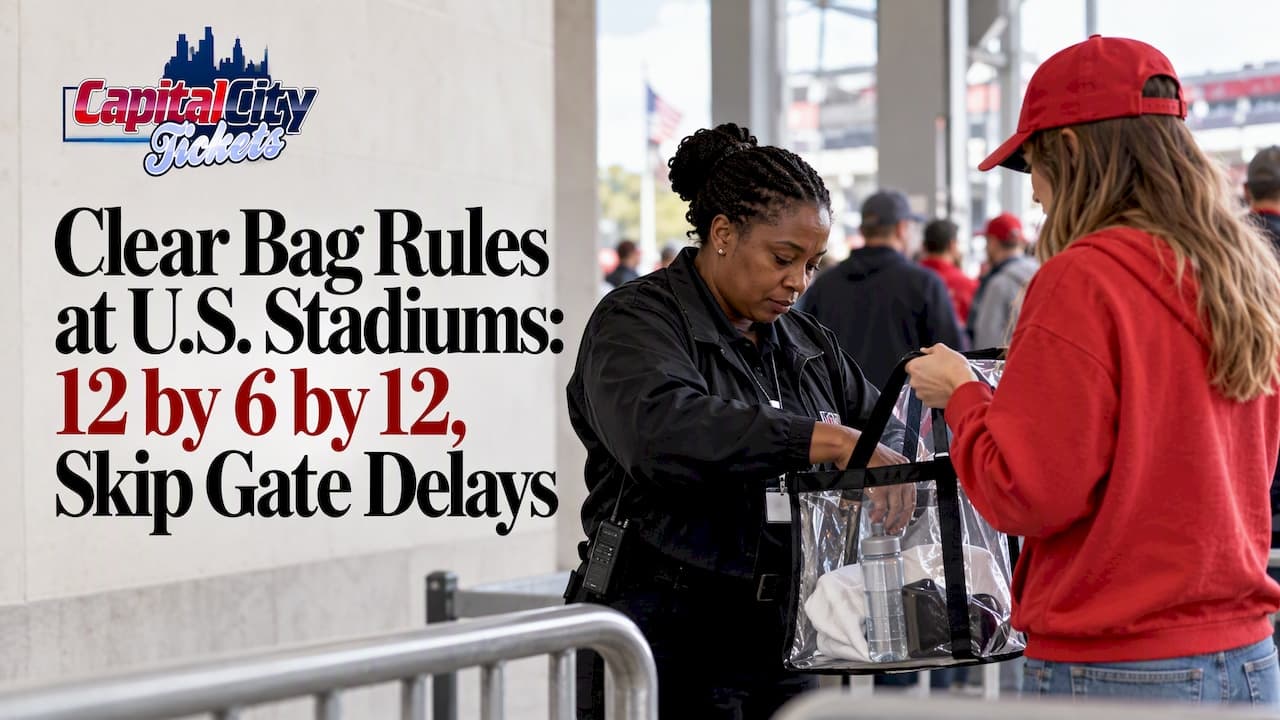
Most U.S. stadiums allow a single clear bag no larger than 12" x 6" x 12" or a one-gallon clear plastic freezer bag, plus one small clutch around 4.5" x 6.5". Staff inspect every bag at the gate, and medical or diaper bags usually get a separate check. Rules vary slightly by venue, so confirm the specifics on your stadium's guest services page before you leave home.
TL;DR:
- A compliant bag must be see through; tinted, frosted, or patterned material and opaque pockets or flaps can fail inspection despite meeting size limits.
- Backpacks, coolers, glass or metal bottles, weapons, and pocketed seat cushions remain prohibited even inside a compliant bag; concerts may add camera or banner restrictions.
- Medical and diaper bags can exceed standard limits, but staff inspect them separately; check the accessibility page for designated entrances and contact guest services beforehand.
- Some venues ban bags entirely for specific events, and concerts may impose promoter rules, so verify the event page during the week before attending.
- Bag valet service is not guaranteed; failed bags may require a return to your car, while traveling without a bag skips the visual inspection step.
Table of Contents
- Which bags are permitted: sizes, materials, and examples
- What items are commonly prohibited even with a compliant bag
- Exceptions and special cases: medical, diaper and accessibility rules
- What to expect at entry: inspections, bag valets, and consequences of noncompliance
- Quick pack checklist: what to bring and where to buy compliant bags
- Publisher perspective: our tips for getting to your seat on time
- How many bags per person and what fits in your pockets
- Why stadiums enforce clear bag rules in the first place
- How clear bag rules differ from stadium to stadium
- Getting through security fast during a big event
- Concerts versus sports games: what changes
- Accommodations for patrons with disabilities beyond medical bags
- Our take: rules are simple, but assumptions cause the delays
- How we help you get to your seat without the gate-day guesswork
- FAQ
- Sources
- Official U.S. stadium and league pages to check before you go
Which bags are permitted: sizes, materials, and examples
The standard rule, used by the NFL's clear bag policy and mirrored across most major league venues, allows one bag per person that is clear plastic, vinyl, or PVC and no larger than 12 inches by 6 inches by 12 inches. A one-gallon clear plastic freezer bag works as an alternative, and you can carry it alongside one small clutch purse.
A compliant setup usually looks like this:
- A clear tote, clear backpack, or clear fanny pack that meets the 12" x 6" x 12" limit.
- A one-gallon clear freezer bag, the kind sold at any grocery store.
- One small clutch, roughly 4.5 inches by 6.5 inches, which can be solid-colored and carried separately from your clear bag.
The material matters as much as the size. Tinted, frosted, or patterned plastic that blocks a clear view inside usually fails inspection even if the dimensions check out. Logos printed on the bag are fine, but zippered interior pouches, buckled flaps, or opaque linings that hide contents from a quick visual scan can get a bag turned away at the gate.
What items are commonly prohibited even with a compliant bag
A clear bag that meets the size requirement does not guarantee entry if it contains something the venue bans outright. Stadiums consistently restrict the following:
- Backpacks, duffel bags, briefcases, and large purses, regardless of material.
- Coolers, hard-sided containers, and glass or metal bottles.
- Seat cushions with pockets or zippers, which can conceal items.
- Weapons of any kind, including pocketknives and pepper spray.
- Large camera bags or cases, though many venues allow cameras carried without a bag.
Concerts and special events often add their own restrictions, such as banning outside alcohol or large noisemakers like air horns and vuvuzelas. Gate staff have the final say, and a bag that looks compliant can still be denied if the contents raise a flag during inspection.
Exceptions and special cases: medical, diaper and accessibility rules
Medically necessary items and diaper bags are typically allowed beyond the standard size limit, but expect a separate inspection, often at a designated gate or guest services window. Staff will usually ask to see the contents rather than wave the bag through untouched.
If you know in advance that you are bringing medical supplies, insulin, feeding equipment, or diapering gear, it helps to notify guest services or check the venue's accessibility page before the event. Some stadiums list a specific entrance for these checks, which cuts down on wait time compared to the general gate line.
Service animals are generally permitted without a bag exception request, and approved seating accommodations may allow a specific type of seat cushion. Infant supplies like formula and bottles usually pass inspection without issue, but pack them in a bag you can open quickly for staff.
What to expect at entry: inspections, bag valets, and consequences of noncompliance
Every bag gets checked, even one that looks obviously compliant. The process usually follows a predictable sequence:
- A visual scan as you approach the gate, where staff check size and material.
- A request to open the bag so contents are visible.
- A pass through a metal detector or handheld wand, sometimes with the bag set aside briefly.
If your bag does not pass, outcomes vary by venue. Some stadiums offer bag-check or bag-valet services, often located at specific gate corners, which may be complimentary for league events or fee-based otherwise. Others will direct you to return the bag to your vehicle, and many stadiums do not provide convenient storage for prohibited items, which can mean a long walk back to the parking lot.
Pro Tip: Bringing no bag at all is still the fastest way through security, since even an approved clear bag adds a visual-inspection step at the gate.
Quick pack checklist: what to bring and where to buy compliant bags
A short packing list saves you from a frustrating moment at the gate:
- A compliant clear bag or freezer bag, or no bag at all.
- Phone, wallet, and keys kept loose in your pockets instead of a bag.
- Medications or medical documentation, packed where you can show it quickly.
- Water only if the venue allows sealed bottles, since rules on outside liquids vary by stadium.
You can find clear totes at most team shops and stadium outlets, often sold right near the entrance for fans who show up unprepared. A plain one-gallon freezer bag from any grocery store works just as well and costs far less. If you are traveling with a group or need extra screening time for medical items, arrive earlier than you normally would.
Publisher perspective: our tips for getting to your seat on time
With over 20 years helping fans attend live events, we have seen how a little prep at home avoids a lot of waiting at the gate. Pairing your ticket delivery method with your bag plan matters: print-at-home and mobile tickets mean one less item to carry, and your will-call pickup window gives you a built-in reason to arrive early enough for a bag check if you need one.
How many bags per person and what fits in your pockets
Most stadiums cap it at one bag per person, whether that is a clear tote or a one-gallon freezer bag, plus the separately allowed small clutch. Bringing a second full-size bag, even a compliant one, typically is not permitted, so couples and families often consolidate into a single shared bag rather than each carrying their own.
Pockets are not regulated the way bags are, so items like your phone, a flat wallet, keys, and a folded ID generally pass through without a second look. This makes pockets a practical workaround for small essentials when you would rather skip carrying a bag entirely. Bulky items like a phone charger, sunglasses case, or a water bottle usually will not fit comfortably in a pocket, which is where the small clutch allowance becomes useful.
Families with young children face a slightly different math problem, since diaper bags are typically treated as an exception rather than counted against the one-bag limit. Even so, it helps to consolidate: one diaper bag per family, checked at a designated gate, tends to move faster than multiple bags split between parents. If your group includes several adults, decide ahead of time who carries the single approved bag so you are not sorting it out in the security line.
Why stadiums enforce clear bag rules in the first place
Clear bag policies exist primarily to speed up security screening while reducing the chance that prohibited or dangerous items slip past the gate unnoticed. A bag that is transparent by design lets staff visually confirm contents in seconds rather than requiring a full manual search of every item, which matters when tens of thousands of fans are trying to get through a limited number of gates in a short window.
The policy also reduces the places where someone could conceal a weapon, glass container, or other banned item. Rather than searching bag by bag at a granular level, which slows entry for everyone, a clear bag makes the inspection largely visual. That is part of why stadiums rarely make exceptions for opaque bags even when they are small.
There is a practical fan benefit buried in the safety rationale: faster, more consistent screening means shorter lines overall. Once you understand that the policy is designed around visibility rather than simply bag size, it makes sense why an oversized clear tote is fine while a small opaque pouch is not. The goal is a quick, confident check, not an arbitrary size limit.
How clear bag rules differ from stadium to stadium
The 12" x 6" x 12" and one-gallon freezer bag standard is widely used, but it is not universal. Some venues, including certain MLS stadiums and college venues, enforce a stricter no-bag policy for specific high-security events, banning bags entirely rather than allowing the standard clear-bag exception.
Other venues, like Chase Field, reiterate the same clear-bag and small-clutch framework but add their own notes on bag-valet locations and search discretion. The core idea stays consistent across most major sports leagues, but the exact wording, approved dimensions, and available services differ enough that it is worth a quick check of your specific stadium's page rather than assuming every venue matches the NFL standard exactly.
Event type matters too. A playoff game or a high-profile concert at the same venue may temporarily tighten the rules compared to a regular-season game, often with extra signage or email notices sent to ticket holders in the days before the event. Checking your venue's policy page the week of the event, not just when you buy tickets, catches these temporary changes.
Getting through security fast during a big event
High-traffic games and sold-out concerts turn a minor bag mistake into a real delay, since lines back up fast when one bag gets flagged. The single biggest time-saver is deciding before you leave home whether you are bringing a bag at all, since a fan with no bag or a pre-checked clear bag moves through the visual inspection step almost immediately.

If you are bringing a bag, pack it loosely. A clear bag stuffed to capacity is harder for staff to visually confirm, and overstuffed bags are a common reason fans get sent to a secondary check or asked to remove items on the spot. Keep your phone, ID, and payment method in your pockets rather than buried in the bag, so you are not fishing for them while staff wait.
Arriving earlier than you think you need to is the most reliable tactic for big events. Gates for marquee games often open well ahead of kickoff specifically because lines are longer, and getting there before the rush means a calm walk through security instead of a sprint against the clock. If your group includes anyone needing a medical or accessibility check, add even more buffer time, since those checks happen at a separate point in the line.
Concerts versus sports games: what changes
The core clear bag rule tends to stay the same whether you are heading to a football game or a concert at the same stadium, but concerts sometimes layer on extra restrictions tied to the performer or promoter rather than the venue itself. Outside food and drink bans are common at both, but concerts are more likely to add specific prohibitions on professional cameras, recording equipment, or large flags and banners.
Security staffing and screening intensity can also shift for concerts, particularly stadium tours with higher-profile headliners, where added metal-detector lanes or wanding stations are common. Sports games at the same venue may feel comparatively faster to enter simply because the crowd arrives more spread out over a longer pregame window, while concert crowds often arrive in a tighter block right before doors open.
If you are attending a touring concert at a stadium you have only visited for games, do not assume the sports-day rules apply exactly as you remember them. Promoters sometimes publish their own supplemental bag and prohibited-item list that layers on top of the venue's standard policy, so a quick check of the specific event page avoids a surprise at the gate.

Accommodations for patrons with disabilities beyond medical bags
Beyond the medical bag exception, most stadiums offer accessible seating, companion seating, and designated accessible entrances that are worth identifying before event day. These entrances often have shorter lines and staff familiar with handling mobility devices, service animals, and specialized equipment without the standard bag-size debate.
Wheelchairs, walkers, and other mobility devices are not treated as bags and pass through their own inspection process rather than being measured against the clear bag limit. Service animals also move through without a bag exception request in most cases, since they are not classified as carried items at all.
If you need a specific accommodation, such as extra time at the gate, assistance carrying medical equipment, or a particular type of approved seat cushion, contacting the venue's guest services or accessibility coordinator ahead of the event is the most reliable way to confirm what is allowed. Policies on approved cushions and equipment vary enough by venue that a quick call beats guessing at the gate.
Our take: rules are simple, but assumptions cause the delays
The clear bag policy itself is not complicated. Most of the friction we see comes from fans assuming their stadium matches whatever rule they remember from a different venue or a different year. A bag that was fine at one stadium last season can get rejected at another this year, especially with the no-bag policies some venues now enforce for specific events.
The bigger issue is treating the policy as a formality rather than planning around it. Fans who decide in advance whether they are bringing a bag, and who check their specific venue's page rather than relying on general knowledge, consistently move through security faster than fans who show up assuming the standard rule applies everywhere. If there is one habit worth building, it is checking the actual event page the week of the game or show, not just when you bought tickets months earlier.
— Capital City Tickets
How we help you get to your seat without the gate-day guesswork
We sell concert tickets, sports tickets, and theatre tickets across the country, backed by a 100% guarantee on authenticity and delivery. Choosing mobile or print-at-home delivery means one less item in your pocket or bag at the gate, and our event emails often include the venue's current bag and entry policies so you are not hunting for that information the morning of the show.
| What you get | Why it helps on event day |
|---|---|
| Mobile and print-at-home delivery | One less item to carry through security |
| Event emails with venue details | Bag and entry rules often included ahead of time |
| 100% ticket guarantee | Confidence in authenticity before you arrive |
| Customer support for entry questions | Someone to ask if your venue's policy is unclear |
If you are planning a game day out, browse sports tickets and lock in your seats before checking the venue's bag policy.
FAQ
Do all stadiums have a clear bag policy?
Most major U.S. sports and concert venues use some version of a clear bag policy, typically allowing a 12" x 6" x 12" clear bag or a one-gallon freezer bag plus a small clutch. Some venues enforce a stricter no-bag rule for specific events, so it is worth confirming your venue's exact policy before you go.
Can I bring a belt bag or fanny pack to the stadium?
A clear fanny pack that fits within the standard 12" x 6" x 12" size limit is generally allowed, since material and transparency matter more than the brand or style of the bag. A solid-colored, non-clear belt bag typically would not meet the clear bag requirement unless it falls under the small clutch allowance of roughly 4.5 inches by 6.5 inches.
Do my travel-size liquids need to be in a clear bag?
Small personal items like travel-size liquids can usually be carried in your approved clear bag or small clutch, since the rule governs the bag itself rather than requiring every item inside to be individually bagged. Policies on outside liquids and sealed water bottles vary by venue, so check your specific stadium's rules if you plan to bring any drinks.
What exactly counts as a clear stadium bag?
A clear stadium bag is one made of see-through plastic, vinyl, or PVC, sized no larger than 12 inches by 6 inches by 12 inches, as outlined in the NFL's clear bag policy. A one-gallon clear plastic freezer bag also qualifies as an accepted alternative at most venues.
Sources
Official U.S. stadium and league pages to check before you go
Review the NFL clear bag policy and your venue's own guest services page, such as Chase Field's bag policy, for the exact rules at your event.