
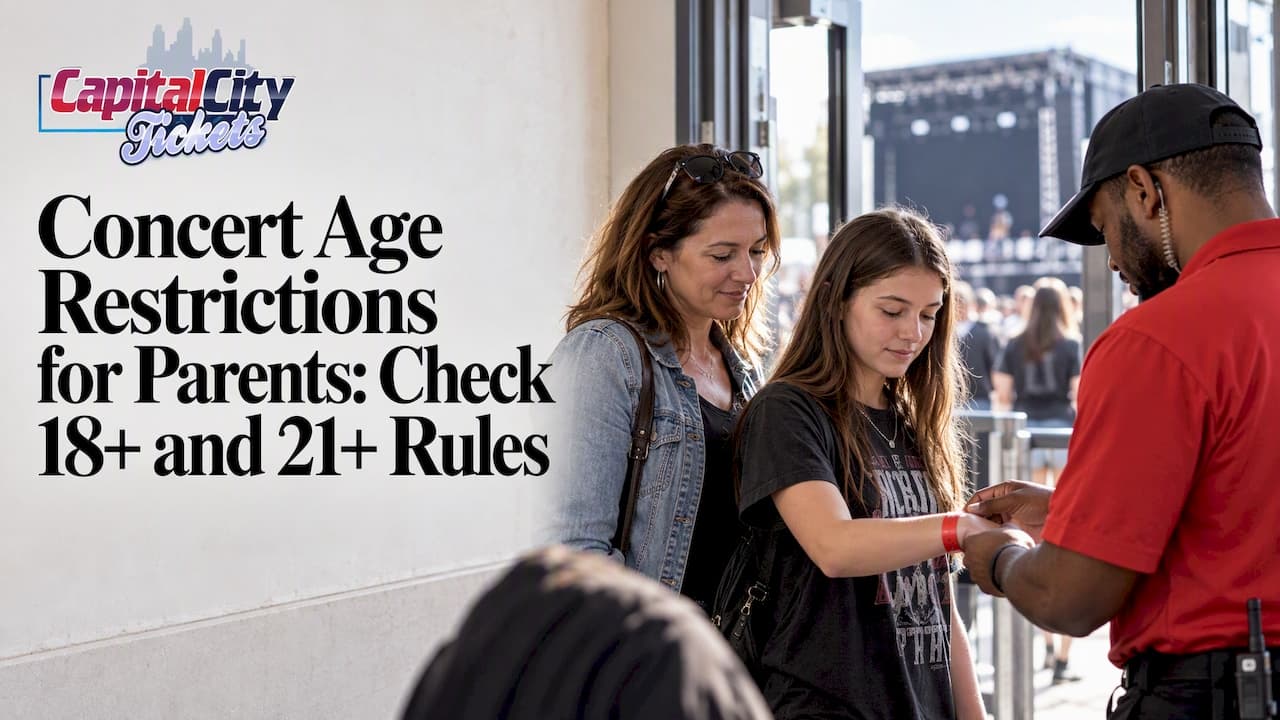
There is no single national concert age law. Venues set their own rules and label shows All Ages, 18+, or 21+, usually tied to liquor licensing, crowd control, or an artist's request. Before you buy, check the event's "Event Info" tab or the venue's FAQ page so you know exactly what's expected at the door.
TL;DR:
- At 21+ shows, every attendee must show valid identification, even when not drinking; All Ages events may still require guardians or tickets for young children.
- Venues require photo ID issued by the government wherever alcohol is served, and minors often cannot reenter after leaving; each attendee may need a ticket.
- NIDCD recommends earplugs or earmuffs for children because concert sound can exceed 85 dBA and cause lasting hearing damage at loud events.
- Check Event Info and the venue FAQ before buying; if rules are unclear, contact the box office about guardians, identification, reentry, and minor fees.
Table of Contents
- What All Ages, 18+, and 21+ Actually Mean at the Door
- Why Venues Set Age Limits: Licenses, Permits, and Enforcement
- Common Venue Policies You'll See at the Door
- Practical Pre-Show Checklist for Parents and Young Attendees
- How to Verify a Show's Rules Quickly
- How We Support Families Checking Event Rules
- A Practical, Safety-First Approach to Bringing Kids to Shows
- Find Tickets and Verify Event Rules With Capital City Tickets
- FAQ
- Sources
What All Ages, 18+, and 21+ Actually Mean at the Door
These labels sound simple, but each one carries different expectations for who gets in and how.
- All Ages: anyone can attend, though a guardian is often required for very young children, and alcohol areas still check ID strictly.
- 18+: only ticket holders 18 and older are admitted, sometimes with a narrow exception for a parent bringing a younger teen.
- 21+: the entire show is treated like a bar, and everyone inside must show valid identification regardless of whether they're drinking.
- Occasional variations like 16+ show up at smaller clubs or specific tours, usually set by the artist or promoter rather than the venue itself.
Operationally, an All Ages label doesn't guarantee a relaxed environment. Blossom Music Center's FAQ notes that children age 2 and under may be allowed free entry on the lawn, but anyone older needs their own ticket. The Strand's FAQ makes clear that even all-ages shows enforce strict ID checks the moment alcohol is involved, and Floore's Country Store spells out that minors need a guardian over 21 to attend at all.
Why Venues Set Age Limits: Licenses, Permits, and Enforcement
Most age restrictions trace back to one thing: the venue's liquor license. When a space can't physically separate the bar from the general crowd, the simplest way to stay compliant is to restrict the whole room to 21 and older. A single violation, like serving a minor, can threaten the license that keeps the venue operating at all.
Smaller clubs without a dedicated all-ages section often default to 18+ or 21+ for the same reason. It's less about excluding younger fans and more about reducing the number of ways staff could accidentally break the law. Policing wristbands and ID checks across a packed room is hard enough without also trying to track which areas a 16-year-old is allowed to enter.
Artists and promoters add another layer. Some tours request 18+ or 21+ limits regardless of venue capability, often tied to the show's content or the artist's preference for the crowd. Local permits and noise curfews can also shape the rules, particularly for late-night sets or outdoor festivals operating under a city ordinance. None of these restrictions are arbitrary. They reflect a mix of legal exposure, insurance requirements, and practical crowd management that most fans never see listed anywhere except the fine print.

Common Venue Policies You'll See at the Door
Once you're past the age label itself, a handful of recurring rules determine whether entry goes smoothly, much like how organizers set strict party bike age rules to ensure safety and compliance.
- A ticket for every person is standard at most venues, with the common exception being children age 2 and under on lawn or general admission seating.
- Government-issued photo ID is required anywhere alcohol is served, and a student ID or school badge typically won't satisfy that requirement.
- Wristbands or ink marks identify anyone under 21 so bar staff can spot them at a glance, a system Floore's Country Store uses alongside a minor entry fee.
- No re-entry for minors is common once wristbanded, meaning stepping outside to meet a ride can mean losing your spot for the night.
- Enforcement is strict because venues risk real penalties, including license suspension, if staff let an unidentified minor into a restricted area.
These rules exist specifically to protect the venue's ability to operate, which is why staff rarely make exceptions on the spot.
Practical Pre-Show Checklist for Parents and Young Attendees
A little preparation avoids most of the problems that come up at the gate.
- Confirm the event's age label and read the venue's full FAQ before you buy tickets, not after.
- Bring a government-issued photo ID for every attendee old enough to need one.
- Keep a physical or digital ticket for each person, including young children if the venue requires it.
- Pack hearing protection: the National Institute on Deafness and Other Communication Disorders recommends high-fidelity earplugs or earmuffs for children at loud events, since sound levels can exceed 85 dBA and risk lasting damage.
- Agree on a meeting point and phone plan in case re-entry isn't allowed.
- Bring any required consent forms if the venue asks for one in advance.
- Call the box office directly when the online policy is vague, and save a screenshot or email confirmation.
Pro Tip: Photograph the venue's posted age policy and ticket terms before you leave home, so you have proof in hand if staff at the door interpret a rule differently than the website.
How to Verify a Show's Rules Quickly
The event's own "Event Info" or "More Info" tab is usually the fastest place to find the real policy, followed closely by the venue's dedicated FAQ page. Both tend to spell out ID requirements, re-entry rules, and whether minors face an extra fee.
When the listing is silent or confusing, a phone call or email to the box office settles it. Ask directly about alcohol access, ID requirements, re-entry, and any minor-specific charges, and request written confirmation if the answer matters for your plans.
- Check the event listing's "Event Info" section first.
- Cross-reference the venue's official FAQ page for standing policies.
- Call or email the box office for anything ambiguous, and keep a copy of the response.
How We Support Families Checking Event Rules
Our listings link out to each event's details so you can review venue policies before you commit to a purchase.
Before buying, it's worth reading up on print-at-home tickets so you know what to bring to the door, and on choosing seats that reduce noise exposure if you're bringing a child to a loud show. If your plans might change, our guide to ticket insurance explains the math worth checking first.
A Practical, Safety-First Approach to Bringing Kids to Shows
Parents asking whether a show is appropriate are usually asking the right question. Checking the venue's actual policy matters more than trusting a show's general reputation. For a first concert, a smaller, milder-crowd show beats an arena headliner, and hearing protection belongs in every parent's bag, not just the diehard fan's. If you're unsure about a listing's details, our support team can help you track down what a venue requires.
— Capital City Tickets
Find Tickets and Verify Event Rules With Capital City Tickets
Once you know a show's age policy, finding the right tickets is the easy part. Our platform lets you filter concert tickets by city, venue, and date, and every order carries our 100% guarantee on authenticity and delivery.
Before checkout, open the listing's "Event Info" section to confirm the venue's age rules match what you're planning for your group.
FAQ
Can a Toddler Attend a Concert?
Many venues allow toddlers at All Ages shows, and some, like Blossom Music Center, let children age 2 and under in free on lawn seating. Always confirm with the specific venue, since policies on tickets and supervision vary widely.
Is There an Upper Age Limit for Concerts?
No, concerts don't set maximum age limits. Age restrictions at venues exist to control who's too young for alcohol or crowd conditions, not to exclude older fans.
Can a Young Teen Attend an All Ages Concert?
Yes, All Ages shows are generally open to teens, though some venues require a guardian for younger attendees depending on the specific event. Checking the venue's FAQ or the event's "Event Info" page before buying is the most reliable way to confirm.
Can a Teenager Attend a Concert Without an Adult?
It depends entirely on the venue and the show's age label. Some All Ages and 18+ events allow unaccompanied teens with a valid ticket, while others require a guardian, so reviewing the specific venue's policy, as outlined by The Strand and similar venues, is the safest step before buying tickets.
Sources
- NIDCD — Protect your child's hearing
- Floore’s Country Store — Venue info
- Blossom Music Center — FAQs
- The Strand — FAQs