
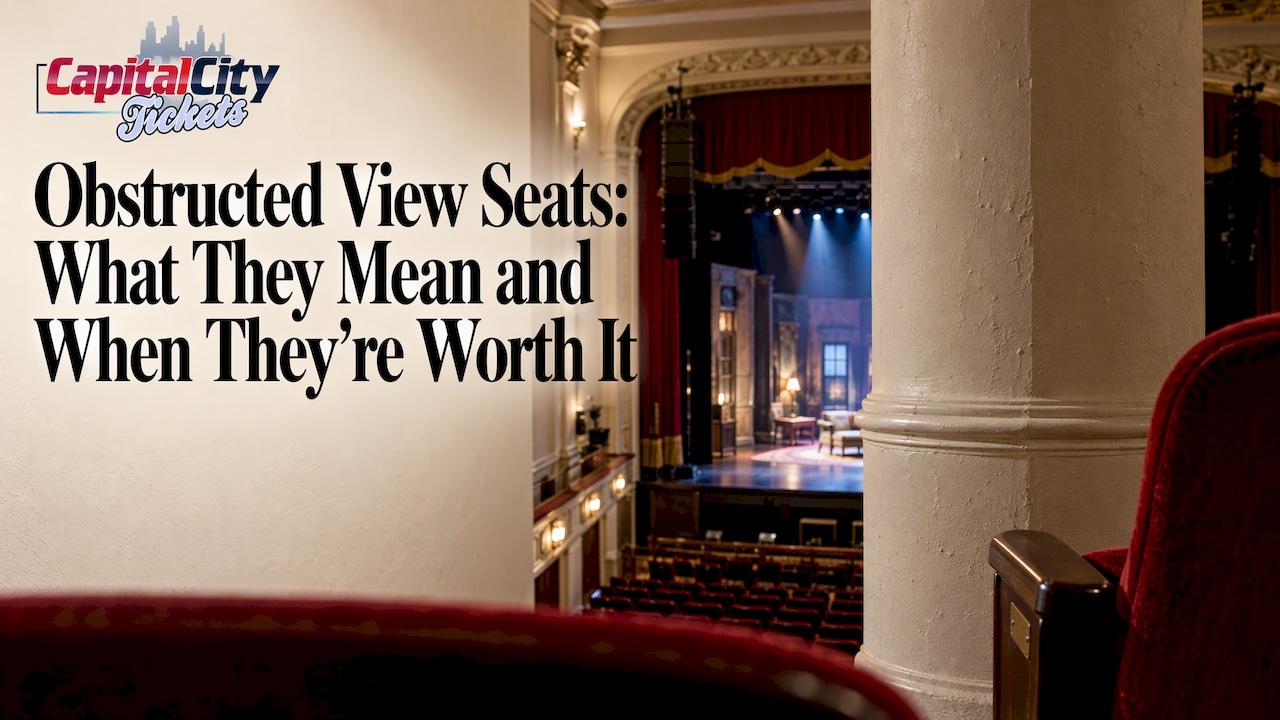
An obstructed view seat is a seat where something, such as a pillar, a railing, a speaker stack, a lighting rig or a steep side angle, blocks part of the stage, court, rink or field. The tickets usually cost less because you give up some of the view, and whether that trade is smart depends on the event, the exact seat and how the seller labels it. Used well, these seats are one of the easiest ways to get into a sold-out show on a budget. At Capital City Tickets you can browse concert tickets, sports tickets and theatre tickets by city, venue, date and category, so you can compare seats before you commit.
TL;DR
- "Obstructed view," "partial view," "limited view" and "restricted view" all warn that you may not see everything. Venues do not always use the words the same way.
- The usual culprits are pillars, rails, sound and lighting equipment, camera platforms and extreme side or rear-stage angles.
- These seats are often cheaper, but the savings only make sense if the missing slice of the show is one you can live with.
- Read the full seat note, find the exact section, row and seat, and keep a record of what the listing said before you pay.
- In New York, the law requires obstructed views to be disclosed on every sale and resale. Elsewhere, rules vary, so the label matters even more.
Table of Contents
- What "obstructed view" actually means
- What blocks the view at concerts, theater and games
- How much of the show might you miss?
- Does the seller have to tell you?
- How to check a seat before you buy
- When a cheaper obstructed seat makes sense
- Buying with confidence
- Where to find discounted seats
- Perspective
- FAQ
- Sources
What "obstructed view" actually means
The plain definition is simple: from this seat, you may not see the whole stage or playing area. The reason can be a structural column, an overhanging balcony, a safety rail, a piece of production equipment or the angle itself.
Venue sites show that the words are used in slightly different ways. Highmark Mann's seating guidance separates two terms: an obstructed-view seat has a pole in the middle with the stage visible on either side, while a partial-view seat has a pole that blocks part of the stage. So at that venue, "obstructed" can mean a thin interruption and "partial" can mean a larger missing piece. Another venue may reverse that, or use one term for everything.
Eventrise's glossary notes that venues also sell these seats as limited view, partial view or restricted view. For you as a buyer, that means the label is a flag, not a measurement. Treat any of those words as a reason to look at the specific seat.
The quick vocabulary
| Label you may see | What it usually signals | What to look for |
|---|---|---|
| Obstructed view | Something sits between you and part of the stage or field | What the object is and where it falls in your line of sight |
| Partial view | A meaningful part of the stage or action may be hidden | Which side or area is hidden |
| Limited view | Less than a full view, often from an angle or from under an overhang | Whether you lose the top, the side or the back of the stage |
| Restricted view | Same idea, sometimes tied to a rail or a screen | Whether the rail is at eye level |
| Side view / behind stage | You see the performance from the wings or from behind | Where the screens are and where the action happens |
This table is a guide to how the words are commonly used, not a rulebook. The seat note on the listing is what counts.
What blocks the view at concerts, theater and games
The cause of the obstruction changes how much it matters, so it helps to know the common ones by event type.
Concerts
Concert venues add temporary pieces to a room: speaker stacks, lighting trusses, video walls and sound desks. Eventrise lists speaker stacks and lighting rigs among the things that can block part of a stage, and it also describes one-show-only blocks, such as a camera platform or a moved sound desk. That is why two seats in the same section can have a different view from one tour to the next.
Seats at the side of the stage or behind it are a special case. You may see the artist's back, but you are very close, and large screens often carry the show. If you are choosing between a clear seat far away and a close, angled seat, the angled seat can be more fun for the right artist.
If hearing comfort matters too, our guide to concert seats that protect your hearing and keep the view walks through where sound is loudest and what to weigh.

Broadway and theater
Older theaters were built with columns, deep overhangs and tight balconies. A pole in the middle of a row, a rail on the front of a mezzanine or a box seat turned toward the stage can each interrupt the sightline. In a theater, what you miss is often the edge of the stage or the top of a tall set, so the question is where the show plays out.
If you are planning a night out on a budget, NPR's guide to cheaper Broadway tickets notes that obstructed- or partial-view seats may cost less, but you may not be able to see the whole stage. That one sentence is the whole bargain.
Before you pick, learn the room. Our walkthrough of how to read theater seating charts explains orchestra, mezzanine and balcony layouts and how to spot the rows where problems tend to sit.
Baseball, basketball, hockey and other sports
Sports venues have their own versions: support columns in older ballparks, overhangs that hide the upper part of the field, glass and boards at a rink, and seats behind a goal or a basket where the angle changes the way you read the play. A column in a ballpark can hide a single base for a moment. Under a deck overhang, you can lose fly balls.
Older parks are the place to be careful. Our guide to Wrigley Field seating and official 3D views shows how to find blocked seats at one of the best-known examples. At a large modern stadium, our piece on SoFi Stadium seats and the official view does the same job.
For racing fans, view issues are different again: a fence, a catch-fence post or a grandstand level can matter more than a pillar, and the distance to the track changes what you see.
How much of the show might you miss?
There is no single number. A thin pole can interrupt a few seats of stage width. A large light at the front of a balcony can hide a big part of the stage: one fan review of a Broadway balcony seat describes more than half the stage hidden behind a large light. That is one person's account of one seat, not a rule, but it shows the range: the same label can cover very different seats.
Three questions get you most of the way to an answer:
- What is the object? A pole, a rail, a speaker stack and a camera platform each hide a different amount.
- Where is it in your line of sight? Dead center is worse than the edge of the stage.
- Where does the action happen? In a musical with a big set, you may lose a scene on one side. At a hockey game, you may lose one corner of the rink.
Does the seller have to tell you?
It depends on where the event is.
New York has a specific law. New York Arts and Cultural Affairs Law § 25.13 requires the operator or promoter to determine whether a seat has an obstructed view and to disclose it, and it requires every sale or resale of that ticket to include the disclosure. Section 25.30 adds that when the operator or promoter discloses an obstructed view, the secondary reseller must pass that disclosure along. It also says views blocked by people in adjacent seats or aisles, objects placed on adjacent seats, and minor or momentary obstructions are not counted as obstructions.
There is no one national rule to lean on. In a Super Bowl case, the Fifth Circuit held that a ticket promising a spectator seat for the game was not breached by an obstructed view of the video board, and that the NFL had no duty to disclose it. You can read the Fifth Circuit's opinion. The lesson for a buyer is practical: do not assume that a missing label means a clear view.
Because the venue decides what counts as an obstruction, the label on your listing is usually only as complete as the venue's information. That is the reason to do your own check of the seat, as described below.

How to check a seat before you buy
A few minutes of looking saves the most common regret, which is finding out at the door.
- Read the whole seat description. Notes about a view can sit in a details panel rather than on the main listing. Look for words such as obstructed, limited, partial, restricted, side or behind stage.
- Pin down the exact seat. Section, row and seat number matter. A seat at the end of a row behind a pillar is a different ticket from one in the middle of the same row.
- Look at the venue's seating chart and any official 3D view. Our guide to finding your seat using stadium seat numbers explains how section, row and seat numbers map onto the chart.
- Consider the type of event. A concert with big video screens forgives a lot. A play with action on the far left of the stage forgives less.
- Save the listing details. Keep a screenshot of the seat, the price and the view note with your confirmation.
- Know what happens if something is wrong. Read the refund terms before checkout. Our summary of the ticket refund policy and what you can get back covers the basics.
When a cheaper obstructed seat makes sense
These seats are a good fit when:
- You care most about being in the room. A packed arena, a roaring crowd and a live band can be worth it even with a pole in the way.
- The obstruction is small or at the edge. A thin column on the side of the sightline is not the same as a rail across the middle.
- The show does not depend on one spot. A concert with screens or a game where the action moves around the whole venue suits these seats better than a play staged in one corner.
- The savings let you do something else. If the difference pays for a second ticket, a family outing or a better night overall, the math can work.
- You are buying last minute. When the good seats are gone, a limited-view seat can be the way to get in at all.
It makes less sense for a once-in-a-lifetime event where the one moment you want is in the hidden zone, or for a child who may not see over a rail. For families, check the rail height and the row: front rows of balconies often have the best sight for small viewers but can come with a rail.
A worked example
Say you want two seats for a touring Broadway musical. The orchestra is out of budget. The listing offers two mezzanine seats at a lower price, labeled limited view. You find the seat numbers, look at the chart and see the seats are at the end of a row, with a rail at the front of the mezzanine. You decide the show is a big-set musical where most of the action is center stage, so you accept the limit. You screenshot the listing and keep the confirmation. That is the whole process: read, locate, decide, record.
Buying with confidence
Seat labels are only part of the picture. The ticket also has to be real and arrive on time. Our guide to verified resale tickets, the FTC rule and our 100% guarantee explains how resale works in the U.S., and our checklist to spot ticket scams is worth a read before any purchase.
Where to find discounted seats
Capital City Tickets sells discounted tickets for concerts, sports and theater across the country. You can filter by city, venue, date and category, use promo codes, and choose last-minute or instant-download tickets. Every purchase is backed by our 100% guarantee on ticket authenticity and delivery.
If you are hunting for a lower price on a show, start with theatre tickets, sports tickets or concert tickets, narrow the list to your city and date, and compare the seat notes on each option.
Perspective
Cheaper tickets are the reason most people find us, and obstructed view seats are part of that story. A seat with a small limit and a big discount can be the difference between going to the show and watching from home.
Our view is that a good deal is a seat you understand. That is why we think the right habit is to look at the section, row and seat before you buy, and to match the seat to the event: a pole matters less at a concert with video screens than at a play staged on one side.
Our site is built around that kind of decision. You can sort by city, venue, date and category, use promo codes, and buy with a 100% guarantee on ticket authenticity and delivery, so the savings come with confidence.
Capital City Tickets
FAQ
What does obstructed view mean at a concert?
It means something may block part of your view of the stage, such as a speaker stack, a lighting rig, a pillar or the angle of a side or rear seat. Many of these seats still have video screens in sight. Check the seat notes and the venue chart to see how much is affected.
Is partial view the same as obstructed view?
Not always. At Highmark Mann, an obstructed seat has a pole with the stage visible on both sides, while a partial-view seat has a pole that blocks part of the stage. Other venues use the words differently, so read the description for the actual seat.
Are obstructed view seats cheaper?
Often, yes. NPR's Broadway ticket guide says these seats may cost less but may not show you the whole stage. The size of the discount depends on the event, the venue and how much of the view is affected.
Does a seller have to disclose an obstructed view?
In New York, yes: state law requires the disclosure on every sale or resale of the ticket. Rules elsewhere vary, so read the listing and the seat details on any purchase.
Can I get a refund if the view is worse than described?
Refund terms depend on the order and the event. Read our overview of the ticket refund policy before checkout and keep the listing details with your confirmation.
Sources
- Obstructed and Partial View Seats | Highmark Mann
- What is an obstructed view seat? | Eventrise
- A guide to finding cheap(er) Broadway tickets | NPR
- New York Arts and Cultural Affairs Law § 25.13
- N.Y. Arts and Cultural Affairs Law Section 25.30
- Opinion, U.S. Court of Appeals for the Fifth Circuit (2016)
- Fan seat reviews, Lyceum Theatre, Broadway | A View From My Seat