
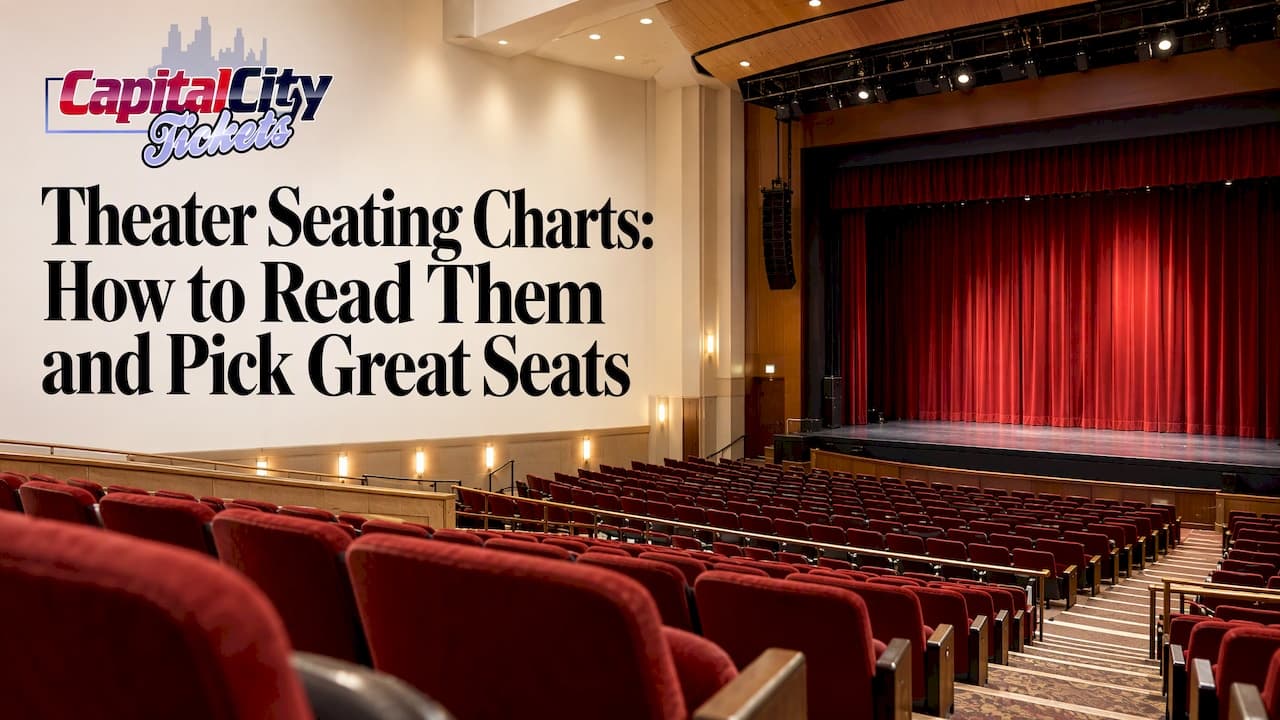
A theater seating chart is a map of the auditorium that shows the stage, the levels, the sections, and the rows and seat numbers inside each one. To read it, find the stage first, then work out which level you are looking at (orchestra, mezzanine or balcony), then check the row letter and seat number. Rows near the front and seats near the center line usually give the strongest view, but the best seat for you depends on the show, the room and your budget.
This guide walks through every part of the chart, compares orchestra and mezzanine seats, shows how to spot possible obstructions, and explains how to use the map to find affordable seats without giving up the view.
TL;DR
- Start with the stage, then the level, section, row and seat number. Names and numbering change from venue to venue, so always read the chart for the exact theater.
- Orchestra seats put you close to the performers. A front mezzanine seat often gives a fuller, wider view of staging, usually at a lower price tier.
- A flat chart cannot show height, overhangs or rails. Look for notes on restricted views and compare with a 3D or seat-view image when one exists.
- Affordable seats are easiest to find in the front of the rear sections, near the center line, and on side seats with a clear angle.
- Accessible seating should be listed with the same detail as every other seat: location, price, view and availability.
Table of Contents
- What a theater seating chart actually shows
- How to read the symbols and notes
- Orchestra vs mezzanine: which is better?
- Finding the best seats in the theater
- How to spot a clear view or a possible obstruction
- Concert seating charts are not theater charts
- Using a seating chart to find affordable seats
- What to verify before you trust a chart
- Our perspective
- Find your seats at a price that works
- FAQ
- Sources
What a theater seating chart actually shows
At its simplest, a seating chart shows sections, rows and seat numbers, and often the stage or performance area. Better charts add more: aisles, entrances, accessible seating, premium sections, pricing zones and notes on restricted or obstructed views.
Venues with detailed charts may also mark the center line, level breaks and overhangs. One performing arts center notes that a chart can show the stage, center line, aisles, level breaks and marked overhangs, and that reading it as a three-dimensional room helps you judge height and route to your seat.
The stage comes first
Before you look at a single seat, locate the stage. Everything else is measured from it. Many charts put the stage at the top, some at the bottom, and a few venues with thrust or in-the-round stages place it in the middle. If you cannot find it, look for the label "stage" or for the curved arc of the first row.
Levels and sections
Most traditional theaters split the house into levels. The ground floor is usually called the orchestra. Above it you often find a mezzanine, and larger houses add a balcony. Charts identify level, section, row and seat, and the names and numbering vary by venue, so "Mezzanine" at one theater can feel quite different from "Mezzanine" at another.
Within each level, the house is divided into sections, typically left, center and right. Boxes, if there are any, sit along the side walls and are often the most unusual seats in the room.
Rows
Rows are normally lettered or numbered, with row A or row 1 closest to the stage in that section. Some theaters use double letters ahead of row A, so the front of the orchestra might be AA. Letters restart on each level, which means row C in the mezzanine is nowhere near row C in the orchestra. Always pair the row with its section.
Seat numbers
Seat numbering is where readers get tripped up. Many theaters put odd numbers on one side of the house and even numbers on the other, with the lowest numbers at the center aisle. In other venues the numbers run straight across a row from left to right. Check the chart's legend or hover over a seat on an interactive map to see the exact label.

How to read the symbols and notes
The small details on a chart often matter more than the section name. Look for:
- Aisle markers. Aisle seats give you leg room and an easy exit, though they may be slightly off center.
- Accessible seating icons. Wheelchair spaces and companion seats are normally marked with the international access symbol.
- Shaded or color-coded zones. Colors usually represent price tiers. A key near the map explains them.
- Restricted or obstructed view notes. These can refer to a pillar, a safety rail, a sound desk or an overhang.
- Partial view or limited view labels. Common for the far sides of a level, where a set piece can cut off part of the stage.
- Disclaimers. Some charts say they are illustrative only and that the layout may vary by event.
That last point is real. A concert, a touring musical and a lecture can all use the same building with different stage setups, so the map you see for one event may not match another.
Orchestra vs mezzanine: which is better?
Neither is better in every case. The choice comes down to how close you want to be against how much of the stage picture you want to take in.
| Orchestra | Mezzanine | |
|---|---|---|
| Location | Ground level, closest to the stage | Elevated level above the orchestra |
| View | Close to performers, faces and expressions; front rows can mean looking up | Higher angle that shows stage patterns, choreography and scenery |
| Sound | Direct and immediate | Often balanced, since you are further back and higher |
| Price tier | Usually the top tiers sit in the center orchestra | Front mezzanine is often priced below the best orchestra seats |
| Best for | Intimate plays, close-up acting, concerts where you want energy | Large musicals, dance, shows with big staging |
The table is a general pattern, not a rule. Real rooms differ. In some theaters, a front mezzanine seat can compare well with a mid or rear orchestra seat for both view and value, because the elevated rake lets you see over the heads in front of you.
When orchestra wins
Choose the orchestra when expressions matter: a drama, a comedy, a small cast, or a singer you have waited years to see. Rows a few back from the stage, close to the center line, tend to feel the most immersive. The very front rows can be too close for large productions, because you may need to tilt your head up to follow the action.
When mezzanine wins
Choose the mezzanine for big shows built around movement: ensemble dance numbers, elaborate lighting and sets that spread across the stage. From above, you see the formations that people on the floor miss. The first few rows of the mezzanine are often the sweet spot, since you are high enough to see the whole stage but not so far back that faces disappear.
The rear orchestra under the overhang
One trap is the back of the orchestra, where the mezzanine above can hang over your head. This can create a low ceiling feeling and can cut off the top of the stage. Check the chart for overhang markings, and if the venue offers a seat-view photo, look at it. Atlantic Street Stages, a performing arts group, cautions that a two-dimensional diagram cannot fully communicate a three-dimensional room, including height, overhangs, rails, acoustics and legroom.
Finding the best seats in the theater
The best seat is whichever one fits the production, the room and what you personally enjoy. The same performing arts center says the best seat depends on the performance, the room and audience preference. Still, a few rules of thumb hold up in most houses.
- Aim for the center line. Seats near the middle of a section give a balanced angle on the stage and balanced sound.
- Think in thirds. The front third is for closeness, the middle third is the all-around choice, and the back third is for savings.
- Match the seat to the show. Spectacle favors height. Intimate drama favors proximity.
- Consider the aisle. If you are tall, need to stretch your legs, or may need to step out, an aisle seat is worth a slightly off-center view.
- Check legroom notes. The first row of a level often has extra legroom because there is no seat in front of you, though that depends on the venue.
If you want a second opinion on how to weigh these trade-offs, this step-by-step event seating guide covers the basic parts of a chart and how to identify a seat. And for advice built around the type of performance you are seeing, choosing seats by view and audience preference is a good companion read for local shows.
How to spot a clear view or a possible obstruction
Sightlines are the real question behind most seating chart searches. A chart will rarely tell you outright that a seat is bad, so you read the clues.
Clues for a clear view
- The seat is near the center line and not under an overhang.
- It sits in the front half of its level, where nothing hangs above.
- The first row of a section, which has no one directly in front of you (check for a rail).
- A raked section, where each row sits higher than the one before.
Clues for a possible obstruction
- Labels such as "limited view," "partial view" or "obstructed."
- Seats at the extreme side of a level, where the angle on the stage is sharp.
- The first row of a balcony or mezzanine, where a safety rail may sit at eye level.
- The back rows of the orchestra beneath a deep overhang.
- Seats directly behind a pillar, sound desk or camera platform, which a chart may mark with a small symbol.
Production details can change all of this. A show with a stage extension, an orchestra pit cover or added lighting towers can shift what a seat sees. When the venue publishes an official, current seating source, treat it as the final word. Some theaters note that production equipment can change accessible-seat availability, and the same equipment can alter standard seating, too.
Concert seating charts are not theater charts
A theater is built for one fixed arrangement: audience in front, stage at the end. Concert venues are more flexible. A hall that holds a play on Tuesday may hold a standing concert on Friday, with chairs removed from the floor or the stage turned to a different side.
What that means for you:
- The chart may show a general admission floor instead of numbered seats.
- Sections behind the stage can be sold or blocked, depending on the production.
- Sound matters more. Seats close to speaker stacks can be very loud. Our guide to concert seats that protect your hearing explains how to balance volume and view.
- Standing room has its own rules. See how standing room only tickets work before you buy.
For big arenas and ballparks, the logic of seat numbers is similar. Our walkthrough on finding your seat from stadium seat numbers is a useful parallel for reading the chart in a larger venue.
Using a seating chart to find affordable seats
Price tiers are built around view and proximity, so cheap seats are not random. They are the ones the venue expects fewer people to want. You can use that.
Go for the front of the back. The first rows of the rear mezzanine or balcony often cost less than the middle of the orchestra, yet they still offer a full-stage view. You trade a little closeness for a lower price.
Look to the sides. Side sections in the orchestra and mezzanine usually cost less than center ones. Choose seats closer to the center side of a side section, not the far edge, to keep a workable angle.
Accept an aisle seat off the center. Aisle seats on the outer sections are sometimes priced the same as others, so you gain leg room at no extra cost.
Check the weekday. Weeknight and matinee performances often sell at lower price tiers than Friday and Saturday evenings, though this depends on the production and the venue.
Filter by price first, then view. Sort by price on the event page, then use the chart to eliminate any seat with a limited view note. What remains are the seats that cost less without a major trade-off.
Use promo codes. Some events accept a promo code at checkout. Always look for the code field before you pay.
A worked example
Suppose a touring musical is playing a 2,000-seat theater with an orchestra, a front mezzanine and a rear mezzanine. The center orchestra rows are the top price. You scan the chart and find that row A through C of the rear mezzanine are priced lower, sit under no overhang and are near the center line. You can check the row A rail note, and then buy those seats instead. You get a clear view of the full stage and spend less. If dialogue matters more than dance, you might choose the side orchestra at row J instead. The chart lets you make that comparison in a minute.

What to verify before you trust a chart
A chart is a guide, not a guarantee. Before you buy, confirm:
- The event setup. Is the map for this specific event, or a generic one for the venue?
- Restricted view labels. Read the full seat description, not only the color.
- Row and seat numbering. Check where seat 1 sits, and whether odd and even numbers are on opposite sides.
- Delivery and seat location. Make sure the section on your ticket matches the one you picked.
- Accessible seating details. The U.S. Department of Justice says that when a venue provides detailed seating maps, accessible seat information must match that level of detail, which typically includes location, price, view and availability. If you need accessible seating, expect to see the same information as for other seats. Our guide to ADA seating, equal prices and how to buy explains the process, and the page on U.S. accessible tickets covers fee transparency.
If you are buying for a ballpark instead of a theater, our guides to the best seats for baseball and Wrigley Field seating show how the same chart-reading habits apply outdoors.
Our perspective
We have spent more than 20 years helping fans get into live events, and the same lesson keeps coming back: the seat map is where a good night is won or lost.
Most people compare tickets by price alone. We think the smarter way is to read the chart first. Find the level, check the row, look for notes on the view, and only then compare the cost. A well-chosen seat in a lower price tier often beats a poorly chosen seat in a higher one.
That is why our platform lets you filter events by city, venue, date and category, and why we stand behind every purchase with a 100% guarantee on ticket authenticity and delivery. Our goal is simple: affordable access to concerts, sports and theater, without the financial strain, and with the confidence that you know where you will be sitting.
Capital City Tickets
Find your seats at a price that works
When you are ready to put the chart to use, browse our theatre tickets and filter by city, venue and date to find the show you want. You can compare sections side by side, apply a promo code at checkout where one is accepted, and buy with our 100% guarantee on authenticity and delivery.
Looking for something different? We also carry concert tickets and sports tickets, including last-minute options for fans who decide late.
FAQ
What are the best seats in a theater?
For most shows, the best seats are near the center line, in the front half of the orchestra or the front rows of the mezzanine. For large, dance-heavy productions, the front mezzanine often shows the whole stage picture. For intimate plays, a few rows back in the center orchestra is a strong choice.
Is orchestra or mezzanine better?
It depends on the show and the room. Orchestra seats bring you close to the performers, while front mezzanine seats give you a higher, wider view and are often priced in a lower tier. Check the chart for overhangs, rails and view notes before you decide.
How do I read row letters and seat numbers on a seating chart?
Row A or row 1 is usually closest to the stage within its section, and some theaters use double letters ahead of A. Seat numbers vary: many venues put odd numbers on one side and even on the other, with low numbers at the center. Always check the chart's legend for the specific theater.
Are concert seating charts different from theater charts?
Yes. Concert layouts can change by event, with a standing floor, blocked sections or a different stage position. Always confirm the map belongs to your specific event, and use the venue's current seating information as the final reference.
How can I find cheaper seats without a bad view?
Sort by price, then use the chart to rule out seats marked as limited or obstructed. The front rows of the rear sections and the center side of side sections are usually the best value. A promo code at checkout can lower the cost further where one is accepted.
Sources
- Choosing a seat: orchestra, mezzanine, balcony and boxes
- How to Read a Theater Seating Chart: Sections & Seats
- How to Read a Seating Chart Before You Reserve
- ADA Requirements: Ticket Sales, ADA.gov
- Choosing the Best Seat: Mezzanine vs Orchestra
- How to pick the right event seating: a step-by-step guide
- Why Attending Live Theater Matters for Your Community